
Have a question about the MASTS Annual Science Meeting? Please feel free to get in touch via masts@st-andrews.ac.uk – we would love to hear from you.
10th-12th November at the Technology & Innovation Centre (TIC), University of Strathclyde, Glasgow
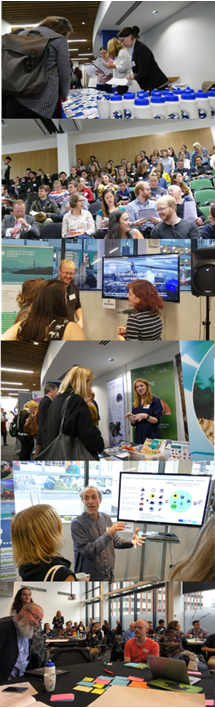
The sixteenth MASTS Annual Science Meeting is a cross-disciplinary event that brings together members of the marine science community, with the aim of promoting and communicating research excellence and forging new scientific collaborations. The event will take place in-person in Glasgow.
The first two days will bring together expert speakers and contributed talks, panel sessions and e-posters outlining the latest research and management practices that address key topics related to marine science and management in the face of global climate change and a biodiversity crisis. Alongside our general science sessions, the event will include special topic sessions, and plenty of opportunities to network. The third day is devoted to workshops.
We invited abstracts for either a general science session, or one of our special sessions as detailed below. Abstract submitters will be contacted by email late September.
These sessions are for any aspect or topic related to marine science. If your work doesn’t fit in the below themed sessions, consider submitting to a general science session.
This session is being promoted by the MASTS AI Forum, Dr Tom Wilding & Dr Ciprian Zavoianu.
Abstracts are invited for 12-minute presentations. Papers can be offered in all aspects of innovative environmental monitoring and/or assessment, including, but not exclusively related to artificial intelligence.
This session is being promoted by the MASTS Aquatic Stressors Forum, Dr Frances Orton & Prof Karen Diele.
Abstracts are invited for 12-minute presentations. Papers can be offered in any field of study related to multiple aquatic stressors (marine, estuarine, freshwater), including, but not exclusively, chemical pollutants, noise, climate change, sewage, electrical fields, multi-variate analysis and modelling etc. Presenters are encouraged to not solely focus on past and current research but reflect on gaps of knowledge and future research directions.
This session is being promoted by the Marine Climate Change Forum.
Climate change is transforming marine and coastal systems at an unprecedented rate, and adaptation to these changes is now requiring a shift from understanding impacts to implementing effective, scalable adaptation actions. This session will explore how science, policy, and practice can come together to deliver meaningful adaptation in the marine environment.
We invite contributions that focus on applied, action-oriented approaches to climate change adaptation in marine and coastal settings. The session aims to highlight real-world examples, innovative solutions, and lessons learned in designing and implementing adaptation strategies. Studies can be global, regional or local in scope, but all submissions are invited to consider how the knowledge can be applied to Scotland.
Submissions are encouraged on a wide range of themes, including:
• Ecosystem-based adaptation and nature-based solutions in marine environments
• Adaptive marine governance, spatial planning, and fisheries management
• Coastal resilience and community-led adaptation approaches
• Monitoring, evaluation, and effectiveness of adaptation interventions
• Decision-support tools, modelling, and technological innovations
• Barriers, enablers, and governance challenges in implementing adaptation
• Case studies demonstrating applied adaptation actions and outcomes
• Integration of Indigenous, local, and experiential knowledge
• Equity, justice, and inclusion in marine climate adaptation
This session aims to:
• Showcase practical adaptation responses in marine systems
• Facilitate dialogue between researchers, practitioners, and decision-makers
• Identify pathways to accelerate implementation and scale-up
• Promote exchange of transferable lessons and best practices
This session is promoted by the MASTS Marine Mammal Research Forum.
Abstracts are invited for long or short talk presentations for a special session that will focus on marine mammals. Contributions are welcomed from all career stages, from anyone working on this topic that would like to present (e.g. academia, consultancy, industry, NGOs). Projects do not need to be complete or have results to be considered for inclusion, and we would welcome early-stage PhD students or similar to consider submitting abstracts.
This session will be Chaired by Dr Chris Leakey, NatureScot.
Exploring natural capital approaches to marine and coastal conservation, this session will share insights on assessment methods, embedding these into policy, and opportunities for responsible investment.
We invite contributions that explore how natural capital approaches can enable marine and coastal conservation outcomes, while also securing multiple benefits for people. We invite perspectives from across the science-policy interface on:
This symposium session will be facilitated by Scotland’s Marine Natural Capital Navigators Hub, a sub-group of the Scottish Forum on Natural Capital. Working across public, private, charitable and academic sectors, we aim to advance natural capital and ecosystem services thinking, research and implementation.
This session will start with a context-setting introduction, with a high-level framing of the natural capital concept, highlighting Scotland’s Blue Economy Vision as a key policy driver for marine and coastal natural capital approaches in Scotland.
Participants will gain:
Additional context:
In the context of ongoing degradation and vulnerability of marine and coastal habitats and species, natural capital approaches provide a framework to advance conservation – to ensure decision-making in all sectors better reflects how people, society and our economy benefit from and depend upon a nature-rich future.
Increasing understanding of marine and coastal natural capital assets, assessment and analytical methods, and how to utilise these in policy and economic contexts, can lead to outcomes such as:
This session is being promoted by the MASTS Coastal Forum and will be Chaired by Prof Stewart Angus & Dr Hon Chim Chiu.
Abstracts are invited for 12-minute presentations (+3 min questions), for a special session that will focus on identifying critical knowledge gaps for management of estuarine environments in the face of social, climatic and environmental shifts. Submissions are welcomed from across all areas of estuarine science and practice, including (but not limited to): cumulative and interacting pressures; integration of marine and terrestrial planning and policy; source-to-sea thinking; climate change adaptation and transformation; natural capital and ecosystem valuation; restoration; modelling and predictive tools. What have we learned to enable and develop new approaches, collaborations, or technologies to reshape our understanding of resilient estuarine systems for the future?
This session is being promoted by promoted by the MASTS NEHM Research Forum and Chaired by Dr Rory O’Hara Murray & Dr Soizic Garnier.
Abstracts are invited for 12-minute presentations or 5 minute speed talks. Particle tracking is a powerful technique with many marine science applications from pollutant dispersal to complex biophysical interactions. Papers can be offered in any field of study related to marine particle tracking, including, but not exclusively, related to aquaculture, sea lice dispersal and wild fish interactions, pollutant dispersal, diadromous fish migrations, sediment transport, larval dispersion. Presenters are encouraged to not solely focus on past and current research but reflect on gaps of knowledge and future research directions.
This session is being promoted by the MASTS Biogeochemistry Research Forum.
Abstracts are invited for 12-minute presentations. Papers can be offered in any field of study related to marine biogeochemistry, including, but not exclusively, the marine carbon cycle, nutrient cycling, marine productivity, particle fluxes and sediment biogeochemistry. Presenters are encouraged to not solely focus on past and current research but reflect on gaps of knowledge and future research directions.
This session is being promoted by Dr Mark Powell and the MASTS Sustainable Aquaculture Forum.
Abstracts are invited for 12-minute presentations (+3 min questions), for a special session on Sustainable Aquaculture. Papers can be offered in any field of study related to aquaculture, including, but not exclusively, aquatic animal health and welfare, genetics, alternative feeds, technological developments, waste recycling and climate change resilience etc. Presenters are encouraged to not solely focus on past and current research but reflect on gaps of knowledge and future research directions.
This session is being promoted by the MASTS Sharkscape project.
Join Professor James Thorburn (ENU) for a collated series of talks about the emerging research and conservation of sharks, skates and rays. There will be no call for abstracts for this session, but if you are interested in contributing, please reach out to Professor Thorburn.
We are excited to announce that the ECOWind programme will be running special sessions at this years ASM. There will be no call for abstracts as this will be a collated panel session (speakers TBC).
As the ECOWind programme comes to it end this event will cover the very latest research break-throughs from the four projects – ECOWind ACCELERATE, BOWIE, ECOWINGS and PELAgIO – covering a range of topics, including:
🔹 Ecosystem-wide effects of offshore wind farms – physical and biological;
🔹 Effects of climate change and offshore wind farms on the marine environment;
🔹 Strategic Compensation recommendations for offshore wind farm effects;
🔹 Spatial Planning and Cumulative Impact Assessment recommendations for offshore wind farms;
🔹 Environmental effects considerations for offshore wind farm consenting.
ECOWind hope to see you there and will keep you posted as the ASM programme develops over the coming months. Feel free to reach out for more information via Champions@ecowind.uk
Look out for the latest ECOWind updates: https://ecowind.uk/
If you have been accepted to present an eposter, please note that Eposters will need to be submitted to masts@st-andrews.ac.uk before close on 30/10/26.
An ePoster is an electronic version of the traditional poster boards, and is displayed on a TV monitor/screen. The ePoster may include text, figures and images, as well as video and animation. Read our guidelines here.
All presenters are encouraged to not solely focus on past and current research but reflect on gaps of knowledge and future research directions. Talks should be accessible to other disciplines, by avoiding jargon and keeping technical details simple. We encourage all presenters to read our general accessibility guidance here to ensure our event is available to all.
You will be able to register for workshops as part of the registration process. Contact us if you would like to host a workshop at the MASTS 2026 ASM: masts@st-andrews.ac.uk
Open to all Workshops
This workshop is being organised by Dr Jason Cleland, Dr Seb Hennige & Prof Murray Roberts
Floating offshore wind (FOW) is rapidly expanding in UK waters with several arrays planned, consented or under construction. One of the key challenges in developing FOW structures is improving their stability. Nature Based Ltd. has innovated the use of kelp as a wave attenuation device to reduce the impact of swell around FOW structures. The impact of introducing these new kelp forests on the marine environment is not well understood. Kelp beds are a Priority Marine Feature (PMF) in Scotland and a Threatened and/or Declining habitat under OSPAR due to overgrazing and climate-driven pressures such as those highlighted in the recent MCCIP report (Hill et al. 2026). Associated fauna within regional species pools (Jarzyna et al. 2025) may form the communities around these natural breakwaters. To understand the environmental impacts, a systematic literature review is underway to answer the following question:
What impact will new kelp habitats attached to offshore artificial structures in UK waters and elsewhere have on the environment?
The purpose of this workshop is to bring together experts on kelp biodiversity, benthic and pelagic ecosystems, regional species pools, environmental impacts of offshore renewables, and climate change. We will explore the key issues, critique the draft evidence synthesis report, identify knowledge gaps, and contribute to a robust final evidence synthesis report that can be used by various stakeholders to make informed decisions.
Expected Outcomes/Outputs: A summary report on the discussion
Organiser: Marta Santos Garcia, 25 spaces.
Modelling provides powerful tools for interpreting observations, testing hypotheses and understanding marine biogeochemical processes, but the range of approaches available and the technical knowledge required to get started can present a barrier, particularly for postgraduate students and researchers with primarily observational backgrounds.
“Getting Started with Modelling: A Practical Workshop for Biogeochemists” aims to make modelling more accessible to the marine biogeochemistry community by introducing participants to a range of complementary approaches and, importantly, demonstrating what they can realistically offer. Rather than focusing on technical depth, the workshop will explore what different models are designed to do, which research questions they are best suited to, their data and computational requirements, and their principal strengths and limitations.
Four speakers will introduce approaches spanning different scales and applications in marine biogeochemistry: Chelsey Baker (National Oceanography Centre) will introduce IPCC Earth System Models and Lagrangian modelling; Joost de Vries (University of Liverpool) will introduce process-based modelling; Nicola Wiseman (University of Liverpool) will introduce machine-learning approaches; and Marta Santos Garcia (University of Edinburgh), workshop organiser, will introduce inverse modelling.
Each presentation will connect the modelling approach to concrete research questions and applications, covering its conceptual basis, required inputs, practical considerations, strengths and limitations.
The introductory sessions will be complemented by two extended practical tutorials. Participants will first explore process-based marine biogeochemical modelling with OceanBioME.jl. A second hands-on session will introduce machine-learning approaches using ABIL.py. Tutorials will be run through a cloud-based platform, avoiding the need for participants to install Python or Julia locally and allowing the practical time to focus on exploring and applying the tools.
The workshop will conclude with a roundtable discussion, providing an opportunity to reflect on the different approaches, discuss how they can complement observations, and consider how participants might incorporate modelling into their own research and training.
Expected Outcomes/Outputs:
By the end of the workshop, participants are expected to:
Where possible, tutorial materials, and supporting resources will be shared with participants after the workshop to enable continued independent exploration and learning.
Organiser: Elizabeth Brown (Haskoning)
Available places: 30
The increasing complexity of marine Environmental Impact Assessment (EIA) and the need for transparent, reproducible workflows are driving the adoption of digital tools such as Quatro and R Shiny within consultancy. This workshop, delivered by marine EIA professionals, will introduce how these tools are applied in real-world projects to support data analysis, reporting, and stakeholder engagement. Through live examples, attendees will see how reproducible reporting and interactive applications enhance efficiency and communication across the EIA process. The session will also highlight emerging digital and regulatory considerations, including evolving expectations around data management, transparency and future-facing requirements in digital compliance. The workshop will include demonstrations of best practice in tool development and collaboration, alongside an optional informal “vibe-coding” session where participants can build confidence in programming with guidance from experienced R programmers. Open to all MASTS attendees, the session provides both practical insight and accessible entry points into digital workflows shaping modern marine consultancy.
Expected Outcomes/Outputs: Attendees will gain an understanding of how Quatro and R Shiny can be applied within marine EIA workflows, informed by real-world examples of analysis, automation, and interactive tool development. They will develop awareness of best practice approaches to reproducibility and collaboration, alongside increased confidence in engaging with programming tools regardless of prior experience. The workshop will support upskilling in modern digital ways of working within the marine consultancy industry, equipping participants with practical insight into how these approaches can improve efficiency, transparency, and communication in project delivery. Participants will also have the opportunity to engage with practitioners and explore implementation challenges, with optional hands-on coding support available. Outputs will include exposure to example applications and shared learning resources, supporting continued skills development beyond the workshop.
Organisers: Prof James Thorburn (Edinburgh Napier University) and Dr Jon Houghton (Queen’s University Belfast)
Places available: 30
The MASTS Northern Ireland Working Group brings people together to improve the links between marine research, policy, and practice across Northern Ireland and Scotland. Although both regions share waters and many of the same challenges, work has often been done separately or on a project-by-project basis, making it harder to tackle bigger issues such as marine planning, conservation, renewable energy, and sustainable fisheries. This workshop will bring MASTS members together to meet and engage with a wider group of people working in this space, helping advance the group’s aims. By bringing together people from universities, government, and industry, the Working Group aims to strengthen connections, raise the profile of Northern Ireland within MASTS, and support more joined-up working across the Irish Sea.
Expected Outcomes/Outputs:
Building on the Belfast workshop, the Working Group will develop a set of practical outputs to help move its aims forward. These will contribute to the Working Group’s aim of producing a clearer picture of marine research and policy across Northern Ireland and Scotland, identifying priorities for working together, and providing accessible summaries for policymakers. A “Who’s Who in NI Marine Science” guide may also be developed to help people find and connect with relevant contacts. These outputs will be shaped by discussions at both workshops. Overall, the aim is to build on early discussions and support more joined-up working between the two nations.
Organiser: Dr Ingrid Kelling (Heriot Watt University)
This is a joint workshop of the MASTS Sustainable Aquaculture Forum and the Women in Scottish Aquaculture (WiSA) initiative.
Places available: 20
Who shapes the future of aquaculture in Scotland, and whose voices are still missing? This session brings together leading practitioners and researchers to examine how power operates across aquaculture decision-making, where women and other underrepresented groups are excluded, and why this matters for both equity and sustainability outcomes.
The panel will explore who holds influence across policy, industry, and communities; identify structural barriers to participation; and discuss the growing evidence that more inclusive, gender-equitable systems can lead to more resilient and sustainable aquaculture practices.
Building on these insights, the session will transition into a hands-on practical workshop where participants will work through real-world scenarios to identify actionable interventions. Together, we will map entry points for change ranging from governance reforms and certification processes to workplace practices and community engagement, and develop concrete strategies to embed gender and justice considerations into aquaculture systems.
This interactive format is designed not only to provoke critical reflection but to equip participants with practical tools and ideas that can be applied in policy, research, and industry contexts.
Expected Outcomes/Outputs:
• A clearer, shared understanding of how power operates within Scottish aquaculture decision-making and where inequities persist
• Increased awareness of the links between gender equity, social justice, and sustainability outcomes
• Identification of key gaps in representation, participation, and evidence
• Strengthened dialogue and connections between participants across policy, industry, and research
• Greater confidence among participants to integrate gender and justice considerations into their own work
• Potential next steps for collaboration, including ideas for research, pilot initiatives, or policy engagement
Organiser: Dr Helena Reinardy (SAMS)
Places available: 40
This workshop will consider the progression in research and testing of methodology for measuring, monitoring, and modelling sea lice dispersal in Scotland. Two years into the initiation of the Sea Lice Risk Framework, we have a significant review on the science underpinning the framework, developments in larval quantification and identification through the BBSRC Sustainable Partnership for Innovation program, and initial testing of an industry-led sentinel cage project. This workshop follows on from the 2024 MASTS workshop on Innovations in Sea Lice Monitoring, and seeks cross-sectoral views and discussions on the way forward for science, regulations, and industry in Scotland.
Expected Outcomes/Outputs:
Open discussion and opinion from cross-sector viewpoints; achievements of the BBSRC SAPI program and direction for future UKRI funding; collective engagement in a technical report with recommendations for an evidence-based sustainable future for the SLRF.
Invite only workshops
Organiser: Henk van Rein & Chris McCabe
This workshop is invitation only.
The INSITE North Sea programme is entering its final year of research into the influence of Marine Artificial Structures in the North Sea. This workshop brings together the three INSITE Phase 3 projects, READ-ME, CoRRODE and VALMAS, to discuss alignment, share findings and prepare for the final year of the programme.
Expected Outcomes/Outputs:
• Sharing of latest INSITE programme findings
• Research alignment opportunities and impact targets agreed for the final year of INSITE
Organiser: Tamara Darbar
This workshop is by invitation only. Please contact the organiser if you would be interested in attending.
This final in-person workshop marks the conclusion of a multi-round Delphi study bringing together an expert panel to deliberate and refine a framework of indicators for assessing Marine Protected Area (MPA) effectiveness. Developed in collaboration with NatureScot, this research delivers a co-created, contextually grounded framework that provides actionable, evidence-based insights for MPA management in Scotland.
Organisers: Beth Scott (University of Aberdeen); Martin Solan (University of Southampton); Katrien Van Landeghem (University of Bangor); Francis Daunt (CEH); Krysia Mazik (University of Hull): Henk van Rein (HMC); Chris McCabe (HMC); and Sean Jamshidi (Crown Estate)
This workshop is invitation only targeting policy and decision makers, marine users and the offshore wind industry. Please contact contact the ECOWind Champions on champions@ecowind.uk if you would be interested in attending this workshop. The deadline to apply to attend is 8/9/26.
The ECOWind programme (Ecological consequences of offshore wind development) nears conclusion of four-years of investigating the ecological and socio-economic effects of offshore wind farm development and climate change on marine ecosystems.
Join the ECOWind team for a two-part interactive workshop which will explore both how ECOWind science can help unlock some of the most significant barriers to offshore wind deployment today, and what a more holistic, ecosystem-based approach to managing the impacts of human activities on the marine environment might look like.
Part 1 of the workshop will look at some of the hot issues in offshore wind, and how emerging evidence can improve impact assessments. In (facilitated?) interactive sessions we will discuss compensation, seabird and fish responses to wind farms, benthic impacts beyond habitat alteration, and how offshore wind expansion interacts with other ecosystem components and human activities. We will engage with stakeholders (SNCBs, regulators and industry) prior to the event to identify priority questions and topics to ensure the workshop focuses on the most pressing issues relating to delivery of OW.
Part 2 of the workshop will be an opportunity to explore new approaches to ensure the sustainable use of our shelf seas. This session will adopt a proactive approach to designing a future policy environment in which interactions between receptors are considered alongside other human activities. Drawing on the extensive data collection and modelling achieved in the ECOWind programme, this session will explore the benefits and challenges of adopting new approaches. Expect a highly participatory interactive session with opportunity to challenge both the science and current practice. Presenters from key stakeholders will ensure that the discussion captures all perspectives.
A full day of ECOWind science presentations on 11th November will provide a comprehensive summary of the new research and tools developed in the programme. This will also serve to prime workshop attendees with our latest scientific findings prior to the interactive sessions the following day.
Expected Outcomes/Outputs:
We are delighted that Institute of Marine Engineering, Science and Technology (IMarEST) has kindly agreed to sponsor the student prizes for the 2026 ASM.
The winners from 2025 were:
You must be a student member of IMarEST to be eligible to win a prize, but membership is free. Sign up here.
Give your organisation exposure to over 300 individuals across three days by becoming an exhibitor at the ASM! The facilities of the Technology & Innovation Centre are available to exhibitors during the ASM. Exhibitors will be in the main conference lobby and are expected to stay for the duration of the conference.
To have a stand at the conference please contact us at masts@st-andrews.ac.uk.
The MASTS ASM is being organised by Dr Emma Defew and Hannah Ladd-Jones.
If you would like to get involved or have a query, please drop us an email. You can stay up to date by joining our email list or following us on LinkedIn
Refunds for cancellations will only be issued until 13th October 2026, but named whole-ticket substitutions are permitted until 1st November with notice to masts@st-andrews.ac.uk
The event will take place in a variety of rooms in the Technology & Innovation Centre (TIC). Information about the building from the TIC is here “Events in the Technology & Innovation Centre: an A–Z Guide”. More information via AccessAble on the building is here.
The event’s reception and posters will be in the main conference lobby on the ground floor at the TIC. Seating is available around the lobby, although this is limited and we ask that this is prioritised for disabled attendees. There are plenty of quiet areas around the TIC. Dietary requirements will be catered for.
Technology & Innovation Centre,
99 George Street,
Glasgow, G1 1RD
+44 (0) 141 444 7000
If you have any questions, requests, or concerns about access at this event, please contact MASTS at masts@st-andrews.ac.uk
Check out the Glasgow Convention Bureau’s meeting planner for details on travel, accommodation etc.
We’re working behind the scenes to bring you a suite of useful, and updateable, resources including:
If you would like to be updated when the resources section is live please let us know.